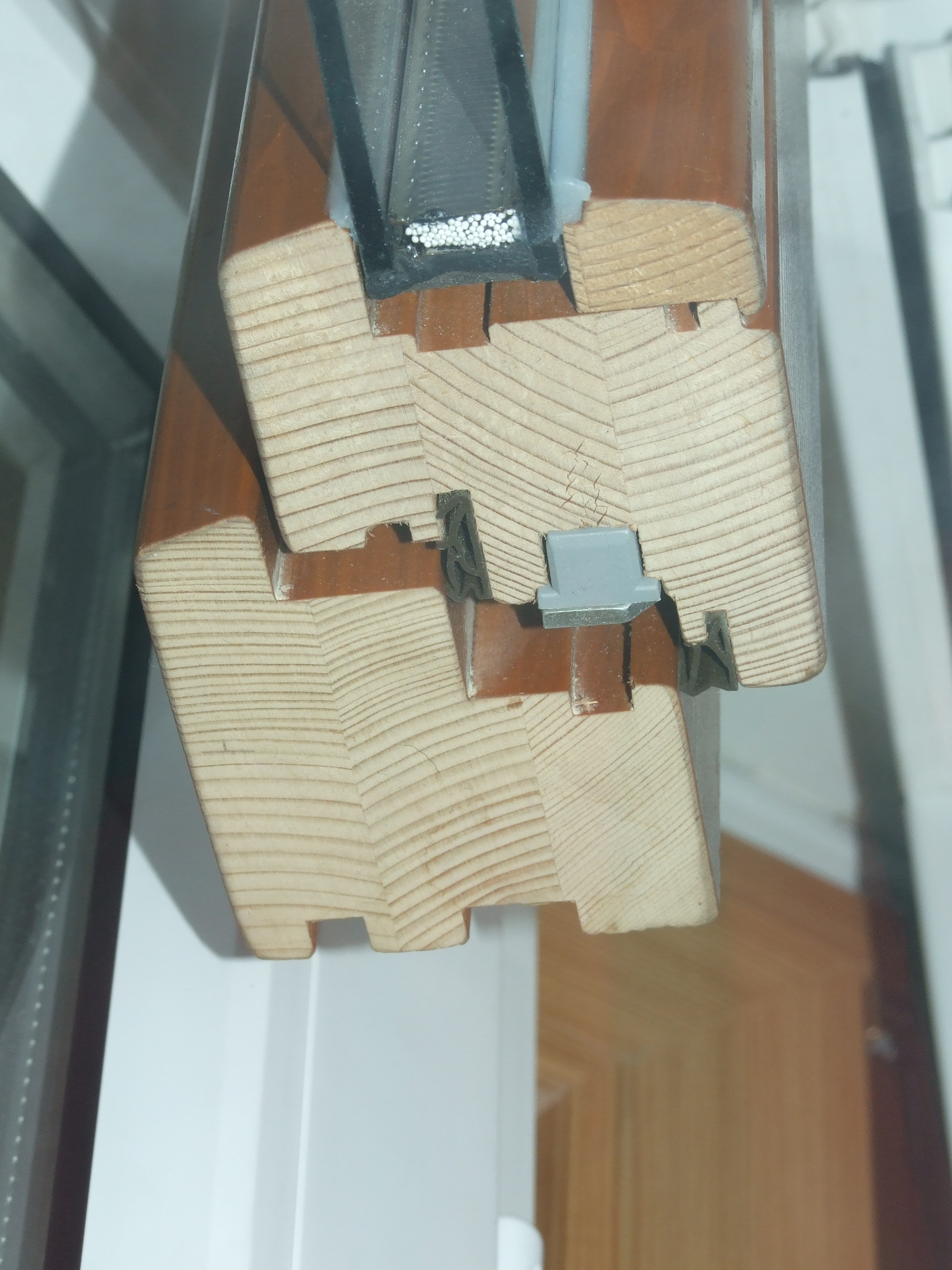
How an insulating glass unit is built
An insulating glass unit (IGU) consists of two or more panes of glass bonded around their perimeter with a sealed cavity between them. The assembly is sometimes called a double-glazed unit (DGU) when it has two panes, or a triple-glazed unit (TGU) when it has three. The cavity width is typically 12–20 mm for a double unit and 10–14 mm per cavity for a triple, giving a total glazing thickness of roughly 24–44 mm depending on configuration.
The primary seal — usually polyisobutylene — sits against the glass edges and provides the gas barrier. A secondary silicone or polysulphide seal bonds the spacer frame to the glass from the outside and carries structural load. This two-seal system has been the industry standard under EN 1279-3 since the early 2000s.
Spacer bars and thermal bridging
The spacer bar runs around the perimeter of the cavity, holding the panes apart at a fixed distance and absorbing the desiccant that keeps moisture out of the gas fill. Aluminium was the original material of choice because it is dimensionally stable and easy to produce at scale. The problem is that aluminium conducts heat very effectively — roughly 200 W/(m·K) — which creates a cold strip along the edge of the glazing, known as the edge effect or thermal bridge.
Warm-edge spacers address this by using materials with much lower thermal conductivity. Stainless steel spacers sit around 15–17 W/(m·K); thermoplastic spacers (TPS) and foam spacers reach 0.2–0.4 W/(m·K). The linear thermal transmittance (ψ, psi) of a warm-edge spacer is typically 0.04–0.06 W/(m·K), compared with 0.08–0.10 for aluminium. The difference is meaningful in practice: switching to a warm-edge spacer on a standard 1230 × 1480 mm window can lower the total window U-value (Uw) by 0.1–0.2 W/(m²·K).
Cavity gas fills
Air has a thermal conductivity of approximately 0.025 W/(m·K). Replacing it with a heavier noble gas slows convective heat transfer across the cavity and reduces the overall Ug value. Argon — used in the majority of IGUs sold in Poland — costs very little to produce and reduces conductivity to around 0.017 W/(m·K). Krypton (0.009 W/(m·K)) performs better and allows narrower cavities, making it the preferred fill for triple-glazed units where total thickness is a constraint. Xenon offers lower conductivity still but is rarely used outside specialist glazing because of cost.
Gas fill percentage matters. A unit filled to 90% argon will perform measurably better than one filled to 70%. EN 1279-3 sets the minimum fill requirement at 85% for units claiming gas fill performance. Reputable manufacturers test fill levels with gas chromatography before shipping.
Low-emissivity coatings
Glass emits long-wave infrared radiation proportional to its surface temperature. A standard float glass pane has an emissivity (ε) of around 0.89, meaning it radiates 89% of the thermal energy of a perfect black body. Low-emissivity (low-E) coatings — typically silver-based thin films applied by magnetron sputtering — reduce emissivity to 0.03–0.05. This dramatically lowers radiative heat transfer across the cavity.
Hard-coat (pyrolytic) low-E is baked into the glass surface during manufacture and is more durable but less effective, with ε typically around 0.15–0.20. Soft-coat (sputter-coat) low-E is applied after tempering and achieves the lower values stated above but must be kept inside the sealed cavity because it degrades on contact with moisture and air. Position matters: for a double unit, the low-E coating is placed on surface 3 (the inner face of the outer pane) in heating-dominated climates to reduce heat loss outward while allowing solar gain inward.
Double versus triple glazing in practice
A well-specified double-glazed unit with argon fill, warm-edge spacer, and a high-performance low-E coating can achieve a Ug of 1.0–1.1 W/(m²·K). Adding a third pane introduces a second cavity and, typically, a second low-E coating, bringing Ug down to 0.5–0.7 W/(m²·K). The difference represents a meaningful reduction in transmission heat loss through the glazed area during a Polish heating season, which runs roughly from October to April and can involve several weeks with outdoor temperatures below −10 °C.
Triple glazing adds weight — typically 15–20 kg/m² against 8–12 kg/m² for double — which affects frame and hardware selection. It also adds 20–35 mm to total window thickness. In older masonry buildings where reveal depth is limited, this can mean that triple glazing will not fit without enlarging the reveal or using a narrower frame profile. These are practical engineering questions that need to be addressed on a building-by-building basis.
| Configuration | Gas fill | Low-E coating | Ug (W/m²·K) |
|---|---|---|---|
| Double / air / no coating | Air | None | 2.8 |
| Double / argon / hard-coat | Argon 90% | Hard-coat ε 0.16 | 1.6 |
| Double / argon / soft-coat | Argon 90% | Soft-coat ε 0.04 | 1.0–1.1 |
| Triple / argon / two soft-coat | Argon 90% | 2× soft-coat ε 0.04 | 0.6–0.7 |
| Triple / krypton / two soft-coat | Krypton 90% | 2× soft-coat ε 0.04 | 0.5 |
Condensation and dew point
Internal condensation on the room-facing surface of a window indicates that surface temperature has dropped below the indoor dew point. For a room at 20 °C and 50% relative humidity, the dew point is approximately 9 °C. A double-glazed unit with Ug 1.0 W/(m²·K) will have an inner surface temperature of around 15 °C in an outdoor temperature of −10 °C at normal indoor conditions, which is above the dew point. A unit with Ug 2.8 W/(m²·K) would drop below the dew point — a practical driver for upgrading to a better specification.
Cavity condensation — misting between the panes — is a seal failure and indicates that the desiccant has been exhausted. This requires unit replacement, not cleaning.