
uPVC frames
Unplasticised polyvinyl chloride (uPVC) dominates the Polish residential window market. According to industry data published by the Polish Window and Door Manufacturers Association (PFSO), uPVC accounts for roughly 70–75% of new window installations in Poland by volume. The material's popularity rests on several straightforward characteristics: low thermal conductivity compared with metals, resistance to moisture, and a competitive price point relative to timber and thermally broken aluminium.
Standard uPVC profiles are hollow, with internal chambers separated by webs. The number of chambers — typically 3, 5, or 6 — determines the basic thermal performance of the frame. A 6-chamber profile with a 70–86 mm overall depth can achieve a frame U-value (Uf) of 1.0–1.2 W/(m²·K) without additional insulation. Some manufacturers fill the chambers with polyurethane foam to reach Uf values below 0.8 W/(m²·K), bringing the profile into territory where it can support passive house window specifications.
The material's weaknesses are dimensional and structural. uPVC has a relatively high coefficient of thermal expansion — roughly 0.06–0.07 mm per metre per °C — meaning a 1500 mm profile can expand or contract by 5–6 mm across the temperature range typical of a Polish year (−20 °C to +40 °C). Manufacturers compensate with steel or composite reinforcement inside the chambers, but the reinforcement itself creates a thermal bridge if it is not separated from the exterior surface. High-quality profiles address this by using stainless steel or glass-fibre reinforcement instead of standard galvanised steel.
Aluminium frames
Aluminium has a thermal conductivity of approximately 200 W/(m·K) — about 2,000 times higher than uPVC. Left unbroken, an aluminium profile would create a severe thermal bridge from interior to exterior. Thermally broken aluminium addresses this by inserting a polyamide (PA66 GF25) strip, typically 14–40 mm wide, between the inner and outer aluminium sections. The polyamide barrier reduces the effective thermal conductivity of the composite frame to a manageable level.
The width of the thermal break determines how well the profile performs. A 14 mm break gives a frame U-value of around 2.0–2.4 W/(m²·K) — adequate for commercial glazing under older regulations but insufficient for the current Polish standard. A 34–40 mm break brings Uf down to 1.0–1.3 W/(m²·K), and some manufacturers reach 0.8 W/(m²·K) with wider breaks combined with additional insulating elements. These systems require careful system design; the European standard EN 14351-1 defines the test procedure and classification of resistance to wind load, water tightness, and air permeability for assembled windows regardless of material.
Aluminium's structural rigidity makes it the first choice for large-format glazing, curtain wall systems, and lift-and-slide or tilt-and-slide doors where span and load requirements exceed what uPVC can reliably deliver. The material also accepts anodising and powder coating in a wide colour range, including wood-effect foils bonded to the aluminium surface.
Timber frames
Solid wood and engineered timber (laminated wood, timber-aluminium composites) remain the benchmark for thermal performance in high-specification residential construction. The thermal conductivity of dry pine — the most common species used for window profiles in Poland — is around 0.12–0.14 W/(m·K), roughly 10 times lower than typical thermally broken aluminium and comparable to uPVC. A well-designed 78 mm timber profile can achieve a frame Uf of 1.1–1.3 W/(m²·K) without supplementary insulation; deeper profiles (92–104 mm) bring this below 1.0 W/(m²·K).
Timber-aluminium composite windows add an aluminium cladding to the external face of the timber profile. The aluminium shell carries weathering loads and is available in any RAL colour; the timber interior remains visible inside and provides the thermal mass and vapour behaviour of solid wood. Composite windows typically achieve Uf values of 0.7–1.0 W/(m²·K) and are common in passive house and nearly-zero-energy (nZEB) projects in Poland.
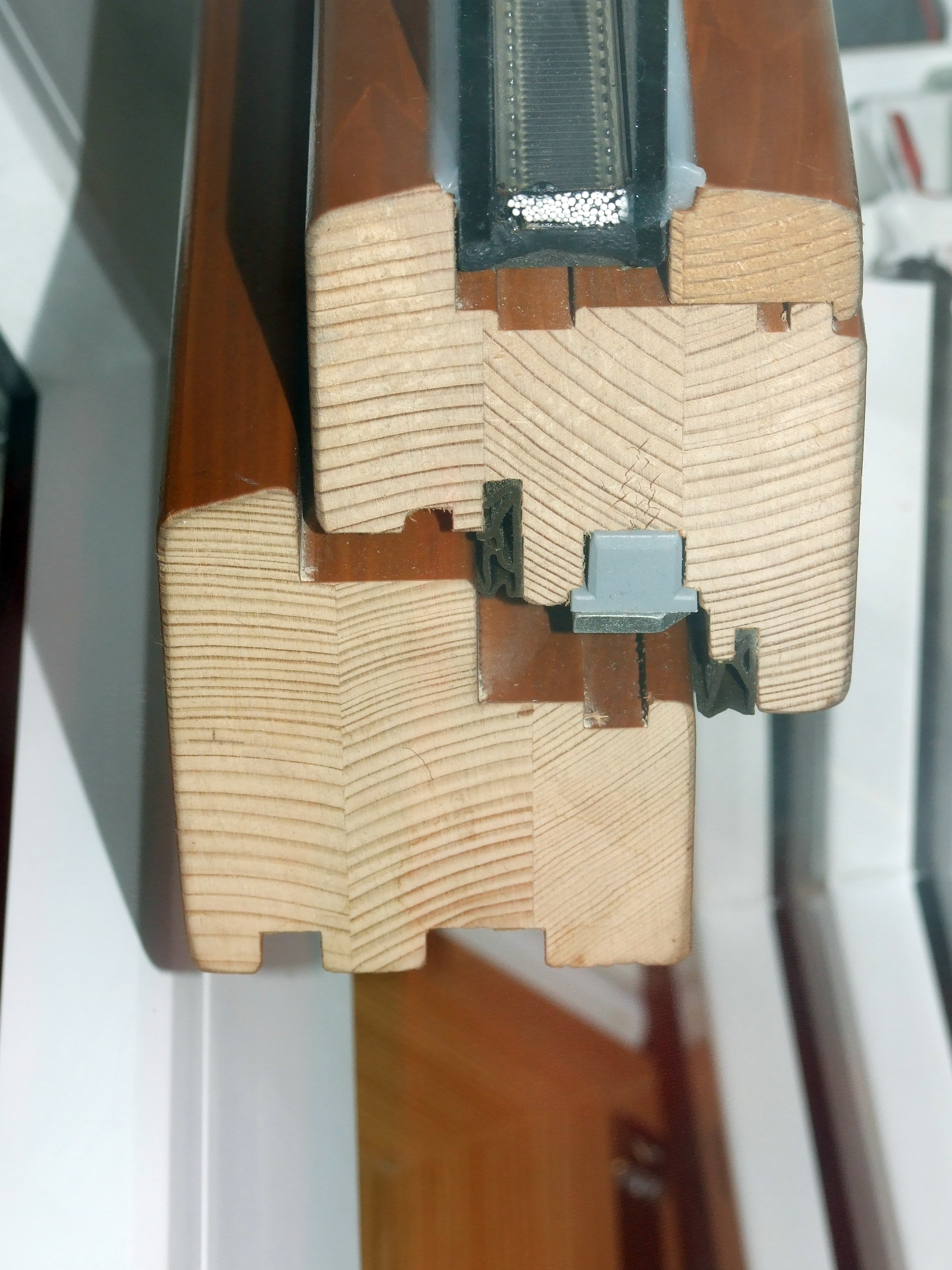
The practical constraint with timber is maintenance. An unclad timber window requires repainting or re-lacquering every 3–6 years depending on exposure, orientation, and coating system. South-facing elevations in urban environments accumulate UV and pollution stress faster than sheltered north-facing positions. Failure to maintain the coating leads to moisture ingress, which degrades the wood and compromises the thermal and structural performance of the frame over time.
Acoustic performance
Frame material contributes to acoustic insulation alongside the glazing specification. The weighted sound reduction index (Rw) of a window assembly is tested under EN ISO 140-3. Dense materials with high mass-per-unit-area perform better at transmitting less sound. Timber and uPVC profiles — being relatively dense and providing some internal damping — perform comparably. Aluminium, despite its rigidity, can transmit structure-borne vibration unless the thermal break also acts as an acoustic decoupling element, which some specialist systems incorporate.
In practice, the glazing specification dominates the acoustic result for most window assemblies. Asymmetric glazing — for example, a unit with panes of different thickness such as 6+16+4 mm — breaks up the coincidence effect and improves mid-frequency sound attenuation compared with symmetric units of the same total mass.
Summary comparison
| Property | uPVC | Aluminium (TB) | Timber |
|---|---|---|---|
| Typical Uf (W/m²·K) | 0.8–1.4 | 1.0–2.4 | 0.7–1.3 |
| Structural rigidity | Moderate (steel reinforced) | High | Moderate–High |
| Maintenance cycle | Low (wipe clean) | Low | High (periodic recoating) |
| Colour options | Foil laminate | Anodising / powder coat | Paint / lacquer |
| Typical lifespan | 25–35 years | 40–50 years | 30–50 years (with maintenance) |
| Relative installed cost | Low | Medium–High | Medium–High |